It is important to tell our stories; the stories of where we come from, the stories of our families, and especially stories of the Holocaust. There are lessons to be learned and applied to situations going on right now in the world. We have seen this before. We have lived it. What kind of people are we? and what kind of world do we want for each other?
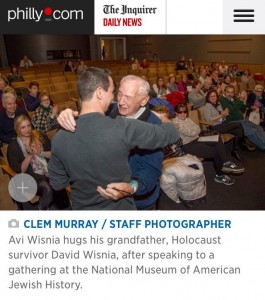
Thanks to everyone who attended the event at the National Museum of American Jewish History in Philadelphia. Read more from an article in the Philly Inquirer.
Read about my recent travels to Poland with my grandfather in the #MyPolishWisnia blog: HERE.
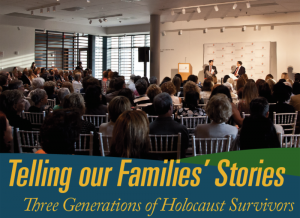
The Holocaust Awareness Museum and Education Center in partnership with the National Museum of American Jewish History is pleased to present “Telling our Families’ Stories,” in which panelists will be speaking about their personal or families’ experiences before, during, and after the Holocaust and discuss what motivates them to keep the stories alive. Join us for a panel discussion including Holocaust Survivor Daniel Goldsmith, Shari Glauser, daughter of Holocaust Survivor Kurt Herman z”l, and Avi Wisnia, grandson of Holocaust Survivor Cantor David Wisnia. After the presentation, there will be options for a docent led tour of the Dreams of Freedom galleries and an opportunity for attendees to do a short video about their own families in the It’s Your Story booth or respond to questions in the Contemporary Issues Forum. Pre-registration requested due to space limitations. Please contact Tammy Forstater at HAMEC at 215-464-4701 or email tammy@hamec.org to register and for further information.
Date: Sunday, April 10. Time: 1:00pm. Admission: Free with Museum Admission. Age restrictions: All Ages. Box office: 215-464-4701. Address: 101 S Independence Mall E, Philadelphia PA
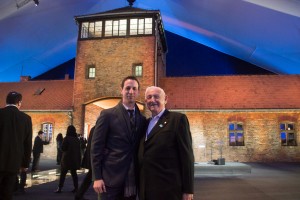
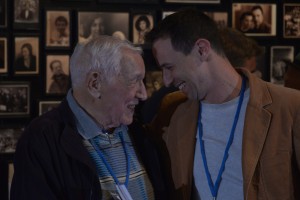
I just returned from traveling through Poland with my grandfather. Together, we did several performances there, taking some time to visit places in Warsaw where my grandfather grew up, and in Auschwitz where my grandfather was held prisoner by the Nazis. It was an incredibly profound journey, and it inspired me to do a lot of writing. Read my blog posts from our time in Poland: HERE.
I am so fortunate to have these moments with my grandfather, experiencing and reliving his life story. His memoir, One Voice, Two Lives, has just been published and is now available online. My grandfather will be doing a book signing event in New Jersey this month (and we may even put a little music together). I am so proud that he is sharing his story with the world. Come and hear his story (and buy his book).
Sat, December 12: Princeton, NJ – Congregation Beth Chaim
More information at www.onevoicetwolives.com
Read the news article about my grandfather’s book and our trip to Poland: HERE.
See my grandfather sing at this year’s Auschwitz Commemoration Event: HERE.
Listen to music I discovered during my time in Poland: HERE.
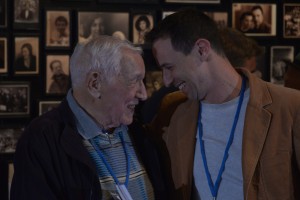
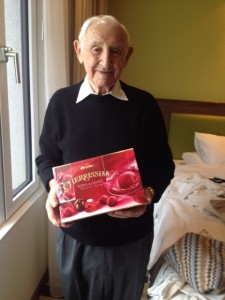
I think we look pretty good for traveling half way around the world, performing a few concerts, and spending days walking around Auschwitz. It is a credit to the amazing friends and strangers we encountered along the way who welcomed us and took care of us. It is also a credit to my grandfather’s sense of humor. During our dinners at the Auschwitz conference, my grandfather would joke, “You know, I never ate this good the first time i was here.”
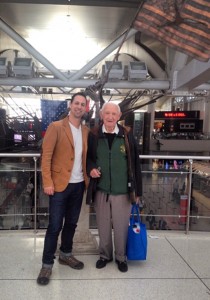
My grandfather especially was glad to be back in the United States. I know he is grateful for everything this country has afforded him, how it gave him a second life. Throughout his entire time as a prisoner in Auschwitz, he always told himself he would make it to America. He would repeat over and over in his mind the addresses memorized from letters his mother had sent to her sisters, his Aunt Rose and his Aunt Helen in New York, the only family he knew he had left. Everything he knew in Poland had been taken away, destroyed, erased, so he had looked to the future. He gave himself a future.
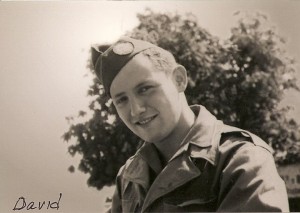
We put our luggage in the shuttle van and got in alongside Charles, a business man who had also been traveling internationally. He was heading to his home not too far from my grandparents’ house in Levittown. Charles did not know what he was in for. Charles spotted my grandfather’s Screaming Eagles jacket. “Are you army?” Yes, my grandfather was a member of the 101st Airborne. After escaping from the death march, my grandfather wandered aimlessly for days on his own until he miraculously crossed paths with a platoon of American soldiers who were rolling through, on a tour of liberation through Germany. They adopted David, calling him Little Davey. He became their interpreter, their mascot, and their little brother. He became one of them, learning English and watching the war from the other side, watching this army barrel through town after town, seeing white flags of surrender from the German population. My grandfather would finally arrive in 1946 on a ship in Hoboken New Jersey, dressed head to toe in his soldier’s uniform, well-fed, his pockets full of money that he had earned employed by the army.
My grandfather spent the entire ride down the NJ Turnpike talking to Charles. They bonded over famous tenors. Charles was familiar with the cantor Moshe Koussevitsky who had coached my grandfather as a boy. They started singing together in the van. With my grandfather, there is always singing.
“This is incredible, I can’t wait to tell my wife about you. She’s gonna flip out. I take this shuttle all the time, and i’ve never had a van ride like this. I can’t wait to tell her.” He matched eyes with my grandfather, and he looked grateful. “You are the first Holocaust survivor I have ever met.”
My grandfather’s house was the first stop, and we took our time getting our luggage out from the back. There was almost no light left outside. We had barely finished saying goodbye to Charles as he took out his phone. I could hear his voice as he called his wife, the van doors still open as we rolled the luggage up to my grandparents’ house. I guess he really couldn’t wait to call his wife.
“Dorothy, let me tell you, you’re gonna flip out. I just met the most remarkable man…”
Yes, he did.
Thank you for sharing our journey. It has meant more than I can say. My grandfather’s memoir is now available at www.onevoicetwolives.com. Read a featured article about the trip and my grandfather’s book HERE.
It was our last night here in Oświęcim. We got back to Hotel Galicja just as another family was checking in. In just a few hours, we would leave for Krakow, and then Vienna, then New York, then Philadelphia. It was going to be a full day of travel, and it had already been one of the most intense days we have had here. Visiting Auschwitz requires a lot of walking, a lot of standing. But the most draining are the memories.
We had earned our coffee, and my grandfather deserved some room service (that would be me). As he was taking my picture in the doorway of our room, the family that had just checked in downstairs came lumbering down our hall, speaking some other language, dragging their luggage behind them. My grandfather, naturally, poked his head out into the hallway. Where are you from? What language is this? The teenage daughter answered us. She was the only member of her family that spoke English, her parents and her younger brother only spoke Hungarian and did not understand. “Hungarian! You know, I know a song in Hungarian…” and my grandfather launched into some Hungarian tune, which I had never heard him sing before. So, I guess, add Hungarian to his list of languages. And then the entire family joined him, singing in the hallway. This was an apparently popular old Hungarian song.
The family looked tired. We were tired too. But upon meeting new people, suddenly my grandfather wasn’t tired anymore. Or he just forgot he was tired. When the family found out my grandfather was a survivor of the concentration camp, their eyes went wide, and they forgot they were tired too.
The daughter explained that they had just arrived to spend a few days visiting the site of Auschwitz-Birkenau. She then translated for her family as my grandfather ran through his history, from growing up outside Warsaw, to the violence he experienced in the Warsaw ghetto, to ending up in this place, a prisoner for over two and a half years. We just got back from visiting the barracks where he slept as a prisoner of Birkenau. The girl looked a little timid. “And what is the difference between Auschwitz and Birkenau?”
A year ago, I would have asked the same question. Because of my travels with my grandfather, I have gotten to know many more survivors and their stories. I have gotten to see so much of Auschwitz and hear experts talk about its history and legacy. I have gotten to understand more and more what my grandfather experienced. The girl’s question made me realize just how much of an education I have received.
Her question was so innocent, and my grandfather answered it without hesitation. They certainly had a lot to learn. Coming to Auschwitz and speaking to a survivor, that is the best way to learn.