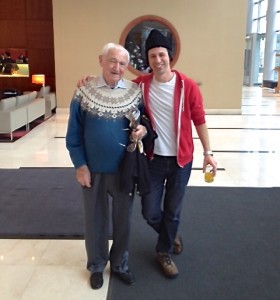
We had one important stop to make on our way through Warsaw before we reached the venue where we would perform. Krochmalna 43.
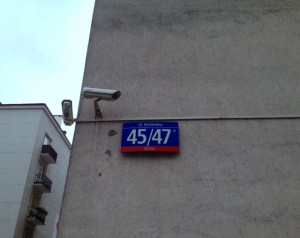
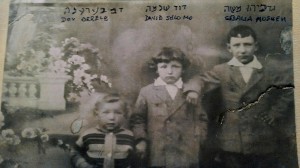
My grandfather grew up on Krochmalna Street, at the corner of Waliców. It used to be rare for me to hear him talk about his childhood and life before the war. He certainly never mentioned his family – his parents, his 2 brothers. In Poland, he talks about them more openly. As we drive around, he keeps mentioning his father, how he would be amazed at all the construction going on, how he should be alive to see it. As we pull up to the street, I realize Krochmalna 43 does not exist. Even though my grandfather refers to the number, there is no Krochmalna 43. The street now starts at 45. Not only is the old building gone, so is the entire address.
He came here to say The Mourners Kaddish, a prayer recited in memory of those who have died. The words, however, never mention death at all. “…Blessed, praised, honored, exalted, extolled, glorified, adored, and lauded…” just endless words of praise that go on like a mantra. I prefer to think of this prayer as a mantra. Because sometimes, it is useless to think of appropriate words. Sometimes, there are no words.
Our driver smoked a cigarette and waited. We got out of the cab, and I followed my grandfather on to the sidewalk. We stood together in the middle of the barren block, at the entrance to a nondescript open driveway, under an empty lamppost. He started the words of the Kaddish, and I joined him. When we finished the last word, we stood there for a moment. Then we got into the cab, the driver flicked his cigarette, and we moved on.
We have been indulging in Polish cuisine: pierogi, kielbasa, cabbage, kluski, and soup. Hot soup. Scalding hot soup. If the soup is not on the verge of boiling, my grandfather will send it back.
Soup is a part of his identity. It is one of the things he remembers most about life with his family, celebrating Shabbat as a little boy growing up outside of Warsaw. For as long as i’ve been around, it has always been one of his greatest joys to prepare his own chicken soup on Friday nights for all us Wisnias.
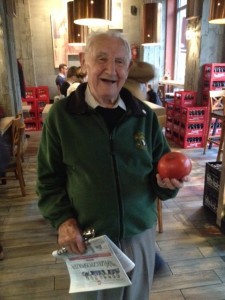
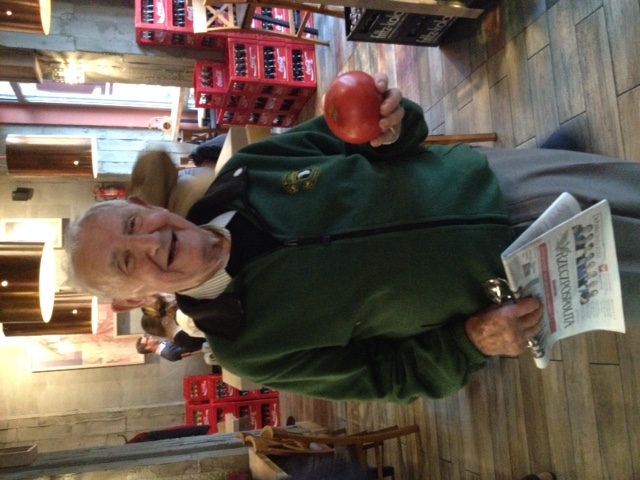
All of that is to say, i just had some incredible pasta bolognese. CUD MIÓD is known for its fresh ingredients, and we were marveling at the giant produce displayed at the front of the restaurant. Zucchinis a foot long, cabbages bigger than your head, tomatoes that you can barely palm. On our way out, one of our servers came over and just gave us one of their big, bulbous tomatoes.
Making friends wherever we go.
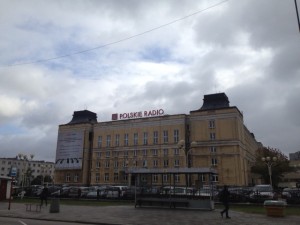
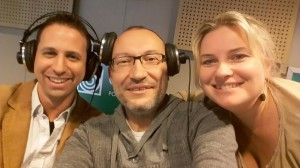
My Polish Wisnia was not feeling well today, and we let him sleep in. Still, the show must go on, and people must know there is a show going on in order to attend the show that will be going on. Off to Polskie Radio.
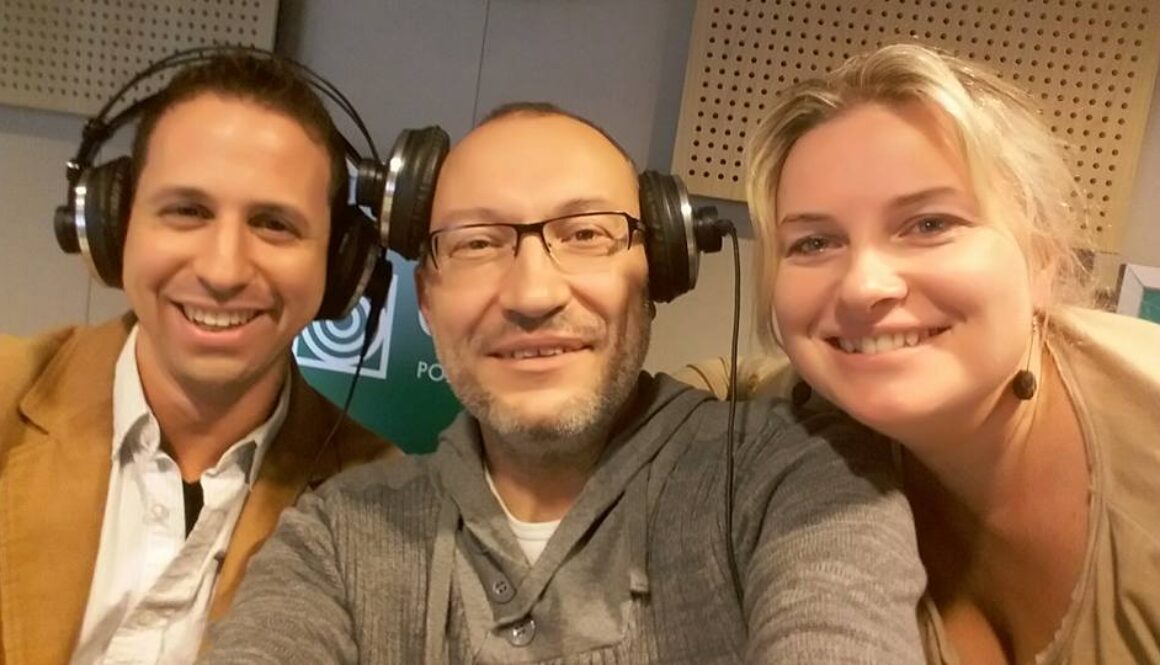
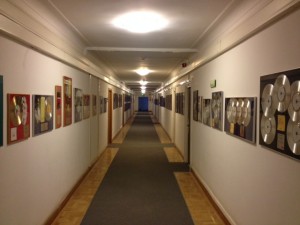
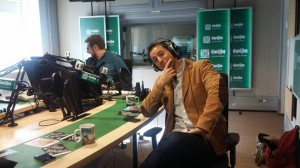
Polskie Radio is like the Polish NPR (My Polskie friends, you may correct the analogy here). My grandfather was very politically aware as a child, always interested in the conversations and political opinions his father would have. He remembers listening to Polskie Radio to get the current events. He was listening to Polskie Radio when Germany attacked Poland on September 1, 1939 – the day after celebrating his Bar Mitzvah. It is disappointing that he did not have a chance to speak for himself on the same radio station he used to listen to, but at least his voice was heard. They played 2 recordings from his old synagogue in Trenton NJ where he was featured as a soloist, backed by full choir and organ. They also played my newest recording, Sky Blue Sky, which made its Polish Radio debut. Rivka talked about the role Beit Warszawa had in hosting us and putting the concert together, and I was asked about my link to my grandfather’s music and the influence he has had on me.
I grew up surrounded by liturgy and Jewish music, hearing my grandfather sing and teach as a cantor and congregation leader. When he sings, it has weight. Everything sounds of sadness and strength. He is always comfortable on stage, always happiest in front of a crowd. I never had any desire to be a cantor, but i can’t deny that my grandfather has shaped me as a musical performer.
Our concert will be a sort of bridge between the old and the new; this is also what these trips have turned into for me. Experiencing my grandfathers story of pain and loss and understanding how it continues to play out; experiencing a new Jewish Poland emerging from the one my grandfather knew which was decimated; experiencing how my path has taken me in a different direction from my tradition but still trying to hold on to it at the roots; understanding the past and claiming it, and finding out how to carry it into the future.
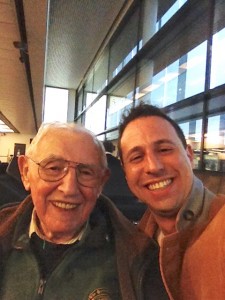
Stopped in Vienna to take a Saba Selfie. The first of many, I’m sure.
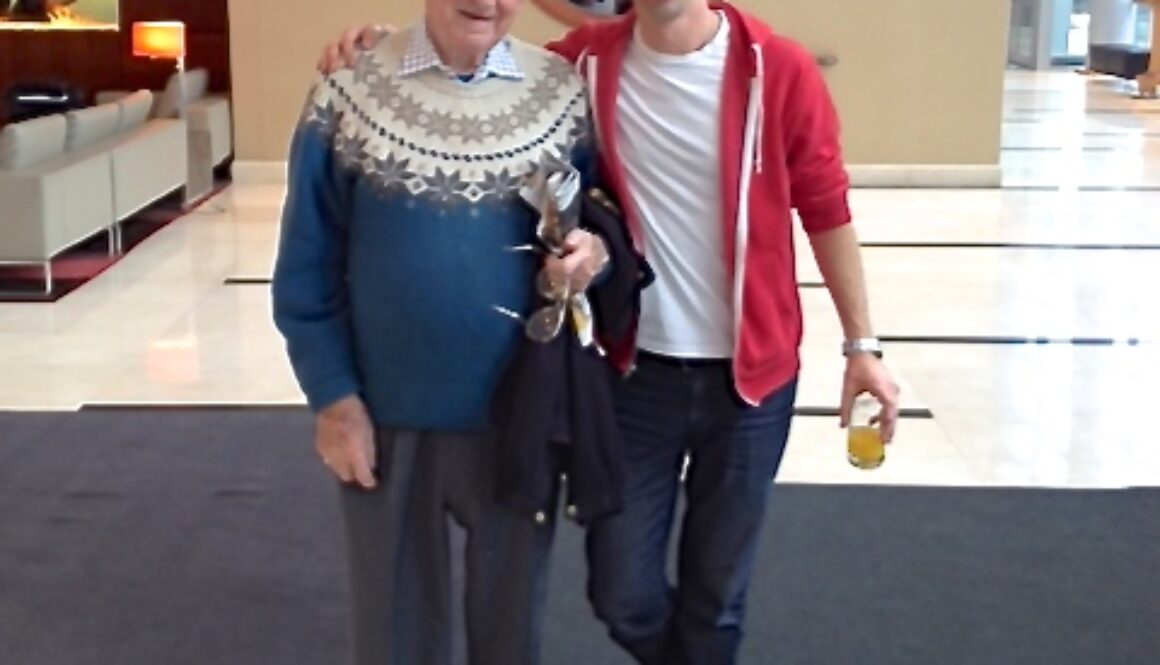
You would never guess my grandfathers age. Especially not after taking a cross-continental red-eye. 10 hours, no sleep, still smiling. Another great thing about traveling with my grandfather: every time I go for a high-five, he never leaves me hanging.
Poland, here we come.
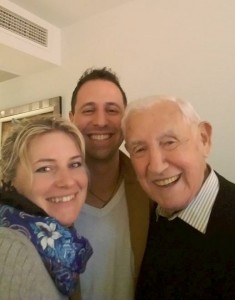
Hello, Poland! another Saba Selfie to celebrate landing safely. and a reunion with our dear friend Iza Rivka, our ambassador to the great Beit Polska Jewish community here, who will be sponsoring our concert.
Watch out Warsaw, The Wisnias are in town.
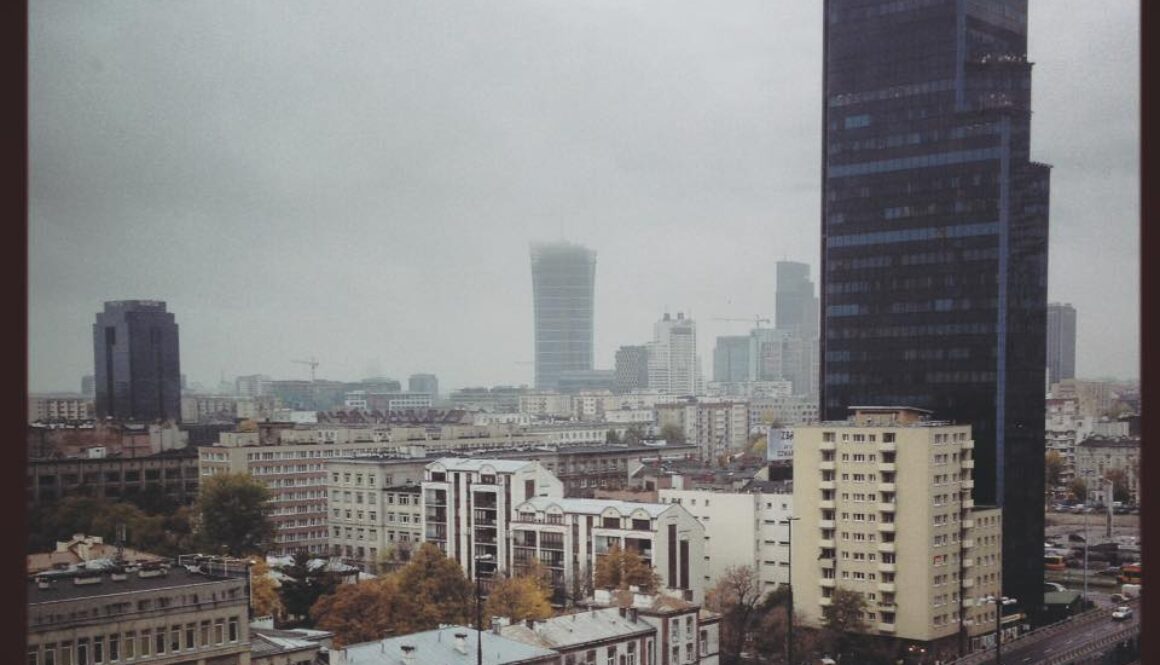
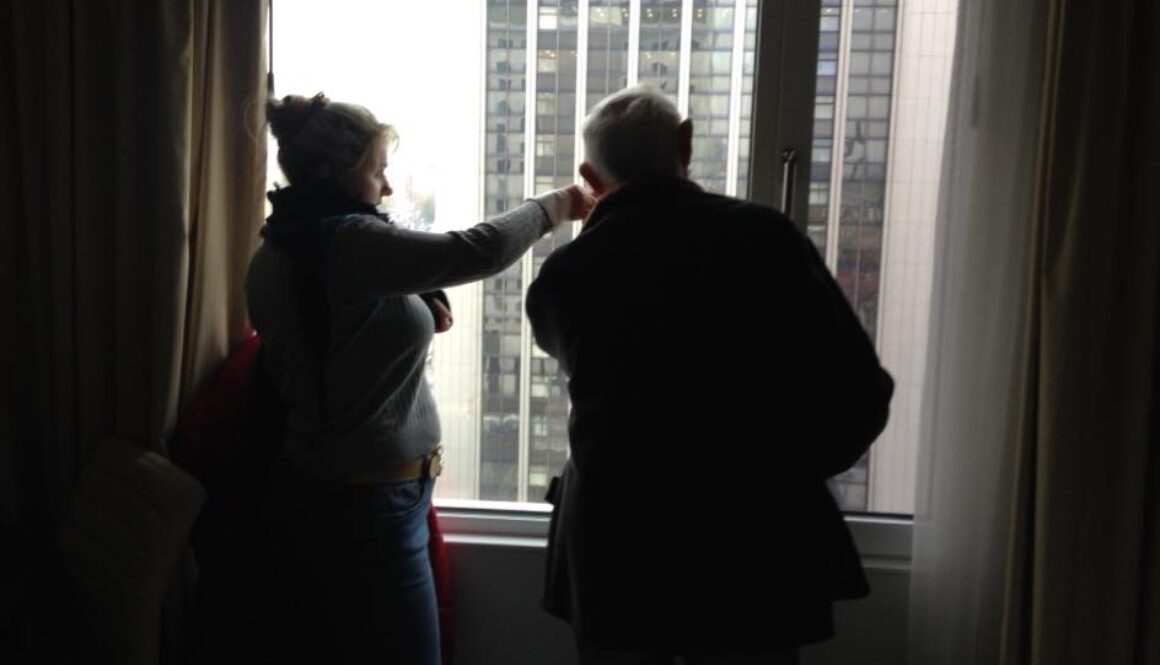
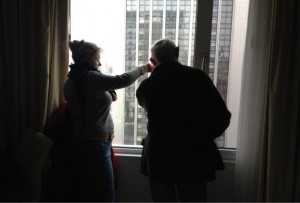
The first thing my grandfather wants to do when we get to the hotel is look out the window at the view. It’s not about the scenery. It’s about personal orientation.
Rivka points us toward Praga, the neighborhood where we will be performing a concert. Praga is where my grandfather ran to in 1941, after he came back at the end of a work day to find his mother, father, and younger brother shot and killed, piled in a human heap by occupying Nazi soldiers in the Warsaw Ghetto. At the age of 16, he had no more family and nowhere to go that was safe. He knew a non-Jewish neighbor that worked as a waitress in Praga. After waiting several hours for her to finish her shift, he was able to reach out to her. She risked her life meeting him and arranging to get him a train ticket out of Warsaw. I picture them parting, attempting to embrace like casual friends, without showing any emotion, so as not to draw any attention. When you’re fleeing for your life, there is no space for mourning.
“For 50 years I have been looking for Wanda. I wish I remembered her last name.” My grandfather does not know if Wanda is still alive. And if she is, would she even know that he is alive? That, in the end, he made it?
We rehearsed for hours and hours. Our concert is going to be a big undertaking. Two hours worth of programming, involving my grandfather’s repertoire, my repertoire, featured singers from the Beit Warszawa community, a Q&A portion, duets and collaborations, and all in a variety of languages.
I have traveled enough to know what it feels like to be a stranger in lots of places. It is easy to be overwhelmed by everything. What makes a successful trip or tour always turns on the openness and generosity of the people who live there. People with such deep pride for where they live and what they do, people who look out for you and invest themselves in your well-being.
We could not have asked for a better host, organizer, friend and collaborator than our Iza Rivka. So, at the end of rehearsal, we surprised her with cheesecake. And honestly, it is the greatest present just to be on the receiving end of a David S. Wisnia rendition of Happy Birthday.
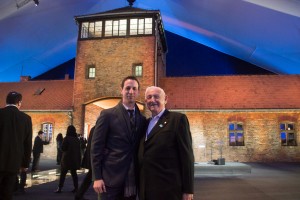
In honor of April’s Holocaust Remembrance Day, my grandfather, Cantor David S. Wisnia, and I will recount our recent travels in Poland, with stories from Warsaw and Auschwitz, and music that we will perform together in two very special events that are free and open to the public. There was much interest in hearing more of my grandfather’s remarkable story and more about our trip, so – for all of you in the Philadelphia/Princeton & NYC area – i am excited to be able to present these events.
MON, April 13: Congregation Beth Chaim – Princeton Jct, NJ WED, April 15: Temple Shaaray Tefila – New York, NY
I have recorded all my posts from the trip on my blogso you can still go back and read them, starting with the first entry HERE, plus a#MyPolishWisnia Photo Albumof the journey on Facebook.
You can also read a NJJN article about our return home HERE.
I’ve been going through my pictures from Poland and this is the last one in the roll. My grandfather gave me this Russian hat to keep me warm on the days we were walking around Auschwitz. Appropriate, since the Russians were the ones to liberate the concentration camp. On our last morning in Warsaw, I decided to wear it to breakfast, as well.
Since I got back home to Philadelphia, I have not been able to stop thinking about a lot of things. For instance, my grandfather’s tattoo. When my grandfather entered Auschwitz, the Nazi guards took away his name and replaced it with a number, 83526. It was one of the many ways they made sure to remind their prisoners that their individual lives had no meaning. Years later, and months after he arrived in the United States, my grandfather went through an expensive and painful plastic surgery procedure to have it removed. His arm was sewn in such a way that the skin kept pulling as it tried to heal together. He could not sleep for a year. Today, still, a curve of the 6 remains. There are survivors of the concentration camps who never had their tattoos removed, but lived the rest of their lives never wearing short sleeves, even in summer, even to the swimming pool. The tattoo is such a cruel metaphor of the legacy of the Holocaust. Even after being liberated from hell, these prisoners are never fully free. How deep does that ink go? What nightmares persist? We can never fully understand, but we owe it to these survivors, and to all those that were slaughtered, to try.
Go. Visit. See the museums, experience the camps, read the stories. Talk about it. The Auschwitz Museum and other organizations like it are doing incredible work preserving the camps and archiving the documents and recounting the stories. Reminding us that this is real. This happened. We need to be honest about history. We need to be honest especially about the darker sides of humanity we don’t want to admit exist. Because they do. As Primo Levi another Auschwitz survivor famously said, “It happened, therefore it can happen again… It can happen anywhere.”
And it does. It continues. Injustice, and cruelty, and oppression, and genocide. They persist. It is easier than we think for injustice to remain hidden until it is too late. So we cannot hide our heads in the sand. Remembering the Holocaust is not enough. Stay informed. Pay attention to the news. Ask questions. Speak up. Voice your opinion. Education is a weapon and a defense against propaganda and fear. Silence is a response. Stillness is a move. I am even more convinced now that we live in a world where we are responsible for each other and we must remind each other of our own humanity.
I have such profound respect for survivors like my grandfather who felt it was within their power to shield their families from the pain and trauma of what they went through. And so we owe it to them to hear their story – when they are ready to tell it, and when we are ready to listen. Already, this trip has started conversations within my own family that we have never had before. Ask your grandparents about their own stories, talk to your parents, your aunts and uncles. Tell your children your story. Do it honestly. The things that happen to us reverberate through the generations and in hearing about them, we can understand ourselves that much more. We all deserve to know where we come from. After my time in Poland, I know I do.
Thank you for going on this journey with me, for sharing your comments and messages. The conversations have made this experience even more meaningful. There are more experiences I want to share and more stories to tell.
More than ever, I feel a responsibility to keep telling these stories. Thank you for listening.