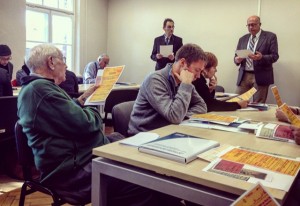
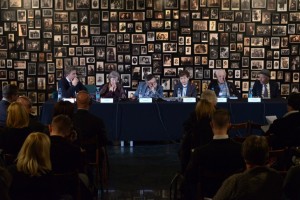
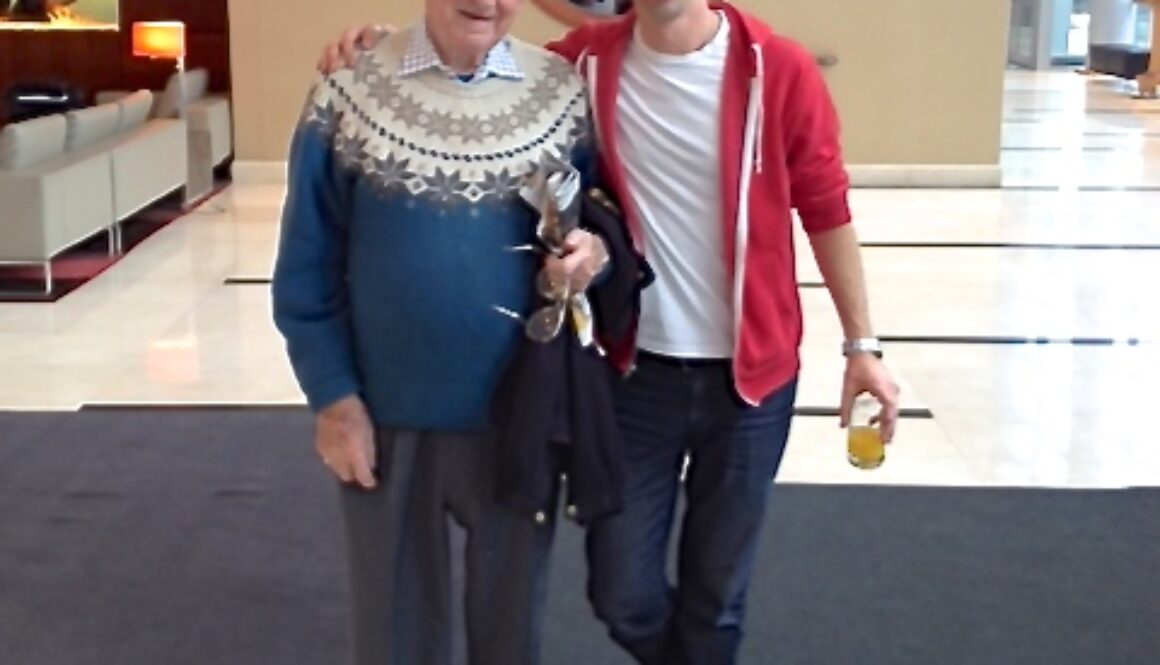
Historians, educators, archivists, advocates, survivors, curators, museum directors; representatives from the Holocaust Museum in DC, Yad Vashem in Jerusalem, Camp des Milles in France, the Anne Frank House in Amsterdam, and many more, all convened in one place, in Auschwitz, to discuss the legacy of the Holocaust.
How are messages of the Holocaust conveyed? How do you teach about the Holocaust? What do we do with oral and material evidence? Is the Holocaust simply a historical account, or does it have implications for today’s world challenges? How do we reach out to younger generations and continue to tell the stories when we no longer have witnesses alive to tell them?
Questions we can all ask ourselves.
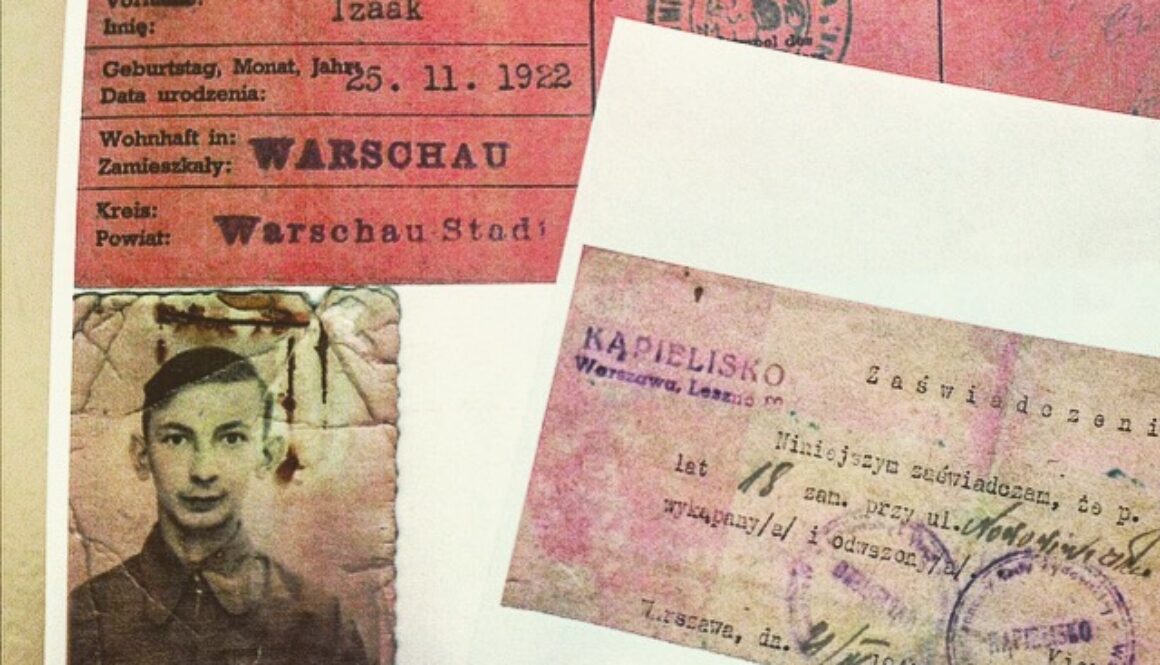
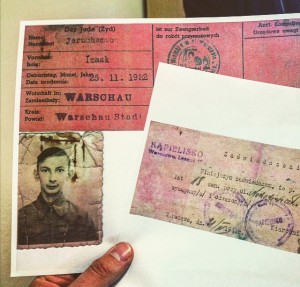
The Holocaust is perhaps the most documented genocide in history. My grandfather and I got a sample of this in January, when Auschwitz archivist Szymon Kowalski showed us documents with my grandfather’s name and prisoner number, detailing some of his time at the camp. At this conference, Professor Jan Grabowski from the University of Ottawa showed us further proof of the Germans twisted fetish for documenting and cataloging their atrocities.
Because of the work of people like Kowalski and Grabowski, not only are we able to retain proof of what happened during the Holocaust, we are also able to attach faces and names to those incidents. The statistics become compilations of real individual stories; people with pasts, people denied a future.
[Read more about the conference, and read survivors’ testimony: HERE]
What does it take to tell your story of survival, to retell and relive those memories? Does it get easier or harder with each visit?
It has become more and more clear to me just how much my grandfather distanced himself from what happened, how he separated and blocked out this earlier part of his life, and how he protected his family from any trauma that he endured. I’m grateful to be able to accompany him as he comes back to Auschwitz, to tell his story. I’m grateful for the platform he is given. He is doing the world a service. The living testimony of survivors is the most important way to understand what happened here.
My grandfather is the strongest human being I know.
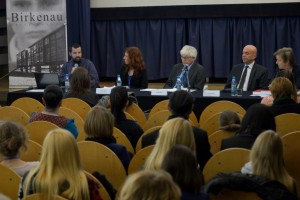
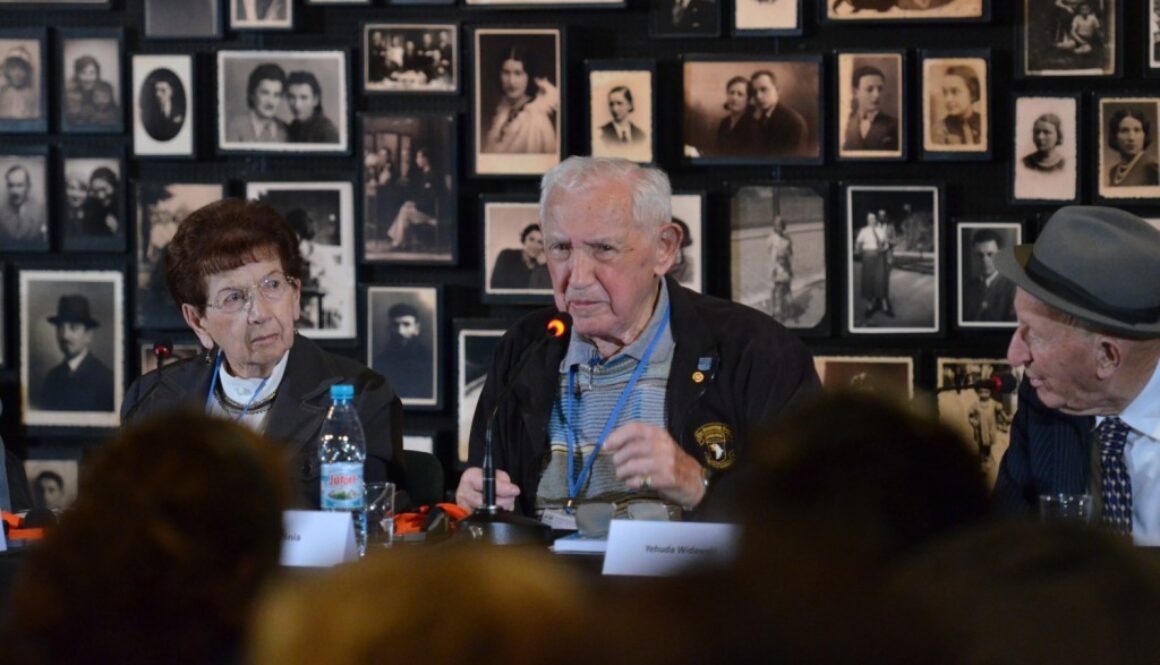
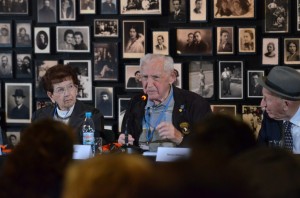
We drove back in to Birkenau as the sun was setting. The opening event of the conference would be a panel featuring 5 survivors of the Auschwitz concentration camp, including my grandfather. The topic: The Impact of the Camp Experience on Post-War Life. I’ve heard him speak many times now in recent years. But something happened on the way in to the panel. We pulled up to one of the prison buildings known as the Sauna, where prisoner clothing was sent for cleaning and delousing. We were walking towards one of the entrances, as my grandfather was remarking about a certain tree. He remembered that tree. We turned a corner. Someone opened a certain side door to the building. And my grandfather stopped cold.
He told the room just a few moments later: “As a prisoner of the camp, I worked exactly in this room for one and a half years. When we moved from the old sauna, I worked here until the evacuation. Somewhere at the back was an office, where I worked. I have been here a few times after the war, but never exactly entered this area. I could not bear it, and today I started crying. I cried for the first time in 70 years.”
[Photo & Quote courtesy of The Auschwitz Museum. Read more about the panel, the survivors’ testimony, and the conference: HERE]
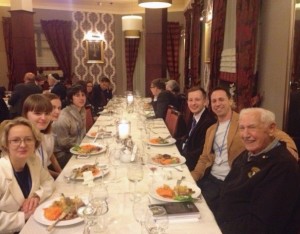
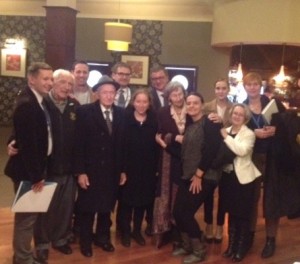
Everything in my family always involves The Meal. Major celebrations revolve around dinner. Family reunions are meal plans with unspecified activities in between, usually snacks. It’s pretty typical to discuss where we are having our next meal while we are eating our current one. So ending the day gathered around the dinner table with all of the participants of the conference felt comfortable and necessary.
Besides, my grandfather is in his prime around people. He is never not happy to meet someone. He is a man who truly celebrates being in the presence of others. He is The Grand Master Schmoozer. After a day of intensity, the company of family, friends, strangers who become friends, is important. Even now, spending time in Auschwitz, revisiting this history, we are able to laugh and joke and relax. Just take your cues from my grandfather. Life goes on.
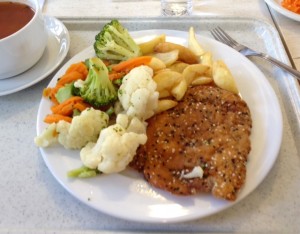
I only know how to say 3 things in Polish. The first thing is: Nie mówią po polsku = I don’t speak Polish. The second thing is a phrase my grandfather taught me that I’d rather not repeat here. And the third is very important, so important that I made sure to know it and commit it to memory before i left: smażony kurczak. It’s not really a traditional Polish dish, but you’d be surprised how much smażony kurczak can be found in Poland, when it’s the only thing you can ask for.
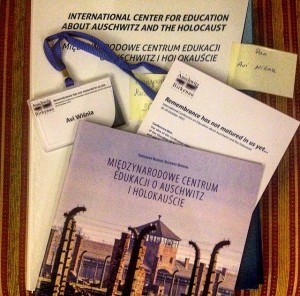
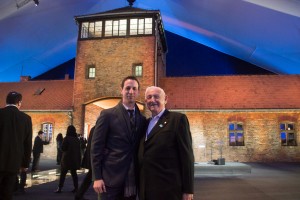
When my grandfather and I attended the 70th Anniversary Event commemorating the liberation of Auschwitz concentration camp back in January, I had no idea that it would bring us back to Auschwitz just a few months later. We have been asked to return by the Auschwitz Memorial Museum to attend the inaugural International Conference on Education about Auschwitz and The Holocaust: Remembrance Has Not Matured In Us Yet… “The idea of the conference refers to the commemoration marking the 70th anniversary and the appeal of the Survivors to take action against hatred and anti-Semitism. The conference agenda will include panel discussions, workshops and presentations and will be held at various places within the Auschwitz Memorial Site. It focuses on issues connected with education about Auschwitz and the Holocaust.”
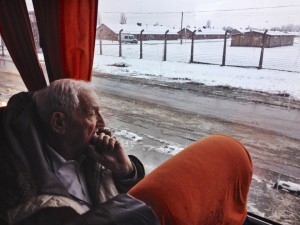
As we travelled from Warsaw to Auschwitz, watching the green Polish country-side pass by, I could not ignore that I was tracing my grandfather’s journey so many years ago, following his evolution from a child of Warsaw to ghetto resident to concentration camp prisoner. I felt it every step of the way. Because there he was, by my side, shadowing his own experience at the same time.
Travel writer Khadijat Oseni asked me to guest blog for her series Jetsetter Problems, based on my previous trip to Auschwitz with my grandfather. Her blog offers a variety of perspectives from travelers and the places they visit, and how those places affect them. My entry set a much different tone than many of her other essays. But i’m grateful that she asked me to contribute and that she felt this specific story was an important one to share. It’s a small sample of what we experienced, and also a sense of what was to come. CLICK TO READ.
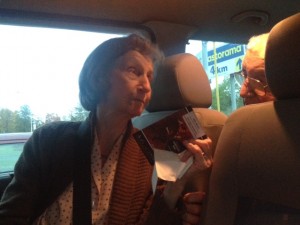
We drove down to Auschwitz from Warsaw in a private van with one other passenger, Zofia Posmysz. Even though we could barely communicate, I liked her from the moment we picked her up. When she got in the car, she took off her awesome vintage 1920’s hat and gave me a Werther’s Original. Zofia had become a prisoner of Auschwitz some time before my grandfather, arrested for handing out leaflets for the Polish Underground resistance. Germany was intent on taking over Poland, and many in Poland were determined to put up a fight. Although Zofia was held in a different part of the camp with other Polish nationals and political prisoners – away from the Jews and other undesirables, my grandfather asked her a few names, to see if they knew similar people. There was some vague overlap, but nothing too revealing. Auschwitz was a huge camp, and I imagine it to be a monumental task to try and unearth faces and names from over 70 years ago, from an era that you spent so much of your life trying to block out. But, for orientation, there is always Your Number.
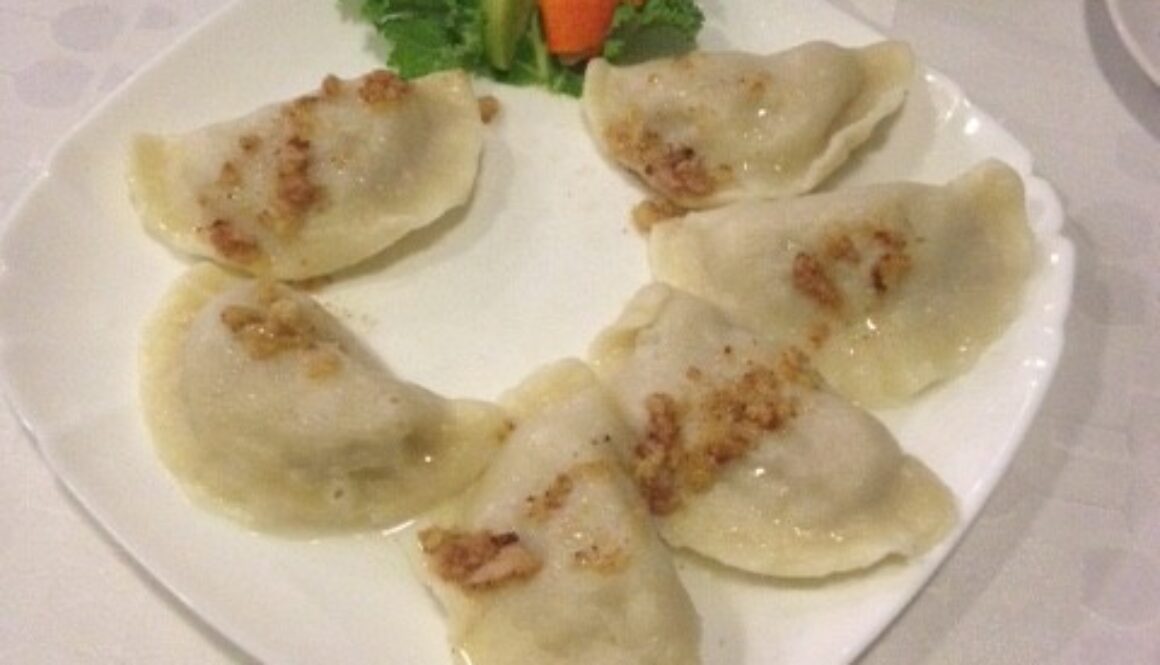
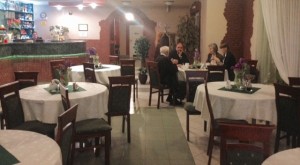
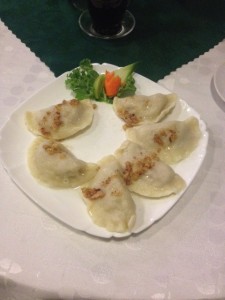
Halfway through the ride, we stopped along the road for pierogies and chicken soup (extra hot). We were the only ones in the restaurant: me, my grandfather, Zofia, our driver Marian, and Klaudia a volunteer from the memorial museum. As we received our coffee (very hot), the Survivors rolled up their sleeves and began to compare. Zofia: 7566. David: 83526, though only the curve of the 6 remains, the rest having been removed. They spoke in Polish, at first serious, and then pointing to their tattooed numbers and laughing. As we walked back to our van, I asked my grandfather what was so funny. He told me: after he came to the United States soon after the war, people would often ask him what the number on his arm was. They had no idea. It was not something you talked about. ‘Eventually, I just started telling people it was my phone number.’ He was telling this to Zofia. ‘Me too!’ she said.
In honor of April’s Holocaust Remembrance Day, my grandfather, Cantor David S. Wisnia, and I will recount our recent travels in Poland, with stories from Warsaw and Auschwitz, and music that we will perform together in two very special events that are free and open to the public. There was much interest in hearing more of my grandfather’s remarkable story and more about our trip, so – for all of you in the Philadelphia/Princeton & NYC area – i am excited to be able to present these events.
MON, April 13: Congregation Beth Chaim – Princeton Jct, NJ WED, April 15: Temple Shaaray Tefila – New York, NY
I have recorded all my posts from the trip on my blogso you can still go back and read them, starting with the first entry HERE, plus a#MyPolishWisnia Photo Albumof the journey on Facebook.
You can also read a NJJN article about our return home HERE.
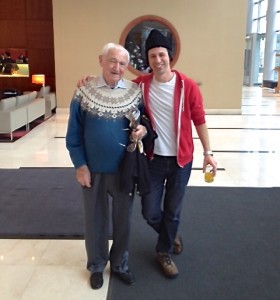
I’ve been going through my pictures from Poland and this is the last one in the roll. My grandfather gave me this Russian hat to keep me warm on the days we were walking around Auschwitz. Appropriate, since the Russians were the ones to liberate the concentration camp. On our last morning in Warsaw, I decided to wear it to breakfast, as well.
Since I got back home to Philadelphia, I have not been able to stop thinking about a lot of things. For instance, my grandfather’s tattoo. When my grandfather entered Auschwitz, the Nazi guards took away his name and replaced it with a number, 83526. It was one of the many ways they made sure to remind their prisoners that their individual lives had no meaning. Years later, and months after he arrived in the United States, my grandfather went through an expensive and painful plastic surgery procedure to have it removed. His arm was sewn in such a way that the skin kept pulling as it tried to heal together. He could not sleep for a year. Today, still, a curve of the 6 remains. There are survivors of the concentration camps who never had their tattoos removed, but lived the rest of their lives never wearing short sleeves, even in summer, even to the swimming pool. The tattoo is such a cruel metaphor of the legacy of the Holocaust. Even after being liberated from hell, these prisoners are never fully free. How deep does that ink go? What nightmares persist? We can never fully understand, but we owe it to these survivors, and to all those that were slaughtered, to try.
Go. Visit. See the museums, experience the camps, read the stories. Talk about it. The Auschwitz Museum and other organizations like it are doing incredible work preserving the camps and archiving the documents and recounting the stories. Reminding us that this is real. This happened. We need to be honest about history. We need to be honest especially about the darker sides of humanity we don’t want to admit exist. Because they do. As Primo Levi another Auschwitz survivor famously said, “It happened, therefore it can happen again… It can happen anywhere.”
And it does. It continues. Injustice, and cruelty, and oppression, and genocide. They persist. It is easier than we think for injustice to remain hidden until it is too late. So we cannot hide our heads in the sand. Remembering the Holocaust is not enough. Stay informed. Pay attention to the news. Ask questions. Speak up. Voice your opinion. Education is a weapon and a defense against propaganda and fear. Silence is a response. Stillness is a move. I am even more convinced now that we live in a world where we are responsible for each other and we must remind each other of our own humanity.
I have such profound respect for survivors like my grandfather who felt it was within their power to shield their families from the pain and trauma of what they went through. And so we owe it to them to hear their story – when they are ready to tell it, and when we are ready to listen. Already, this trip has started conversations within my own family that we have never had before. Ask your grandparents about their own stories, talk to your parents, your aunts and uncles. Tell your children your story. Do it honestly. The things that happen to us reverberate through the generations and in hearing about them, we can understand ourselves that much more. We all deserve to know where we come from. After my time in Poland, I know I do.
Thank you for going on this journey with me, for sharing your comments and messages. The conversations have made this experience even more meaningful. There are more experiences I want to share and more stories to tell.
More than ever, I feel a responsibility to keep telling these stories. Thank you for listening.